Wheel of Fortune Tarot Card Meaning
Wheel of Fortune
Pamela Colman Smith, 1909
- Upright
- cycles · change · turning points
- Reversed
- resistance to change · setbacks · feeling stuck
- Arcana
- Major · Number X
- Element
- fire
- Learn it in
- Day 13 of the 30-Day Tarot Path
In short
The Wheel of Fortune is the card of cycles and turning points. Upright, it points to change, timing and seeing your life as part of a larger rhythm. Reversed, it can show feeling stuck, repeating old patterns, or fighting change you cannot control. The wheel keeps turning; the card asks how you choose to ride it.
What you see on the Wheel of Fortune card
Look first, read later: this is the Image-First Method from Day 5 of the course. Start with what is actually in the picture.
- Figure
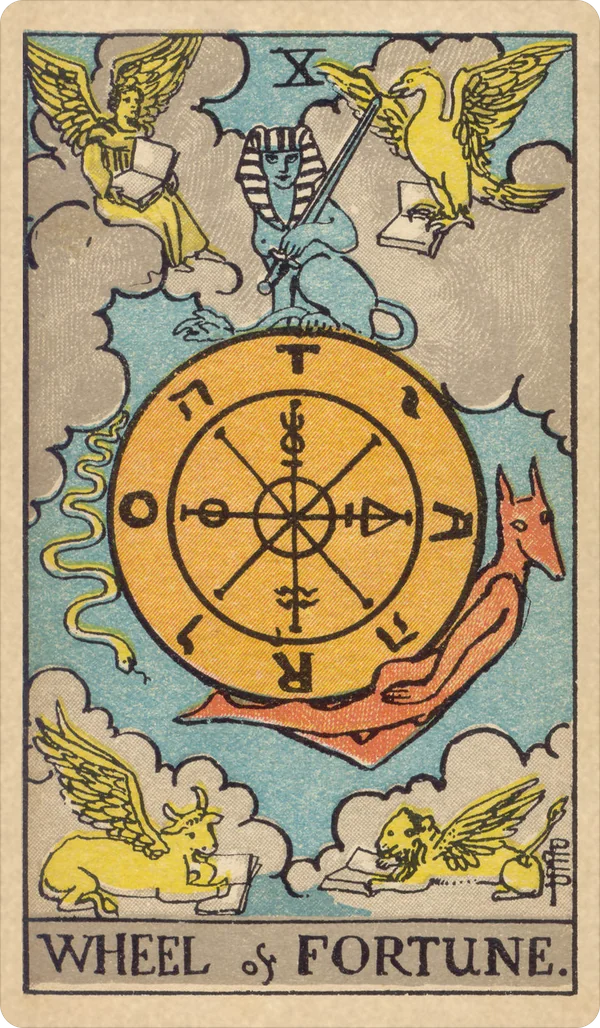
- A large orange wheel floats in a blue sky full of gray clouds. Its outer ring is lettered T, A, R, O, mixed with Hebrew letters, and its spokes carry small alchemical symbols.
- Action
- Three creatures move around the wheel. A blue sphinx sits calmly on top holding a sword, a yellow snake slides down the left side, and a red jackal‑headed figure rises along the bottom right.
- Setting
- There is no ground on this card. Everything floats among the clouds, as if the scene is taking place outside ordinary time.
- Color
- Warm orange and yellow stand out against pale blue and soft gray, with the red jackal figure adding a strong accent.
- Detail
- In the four corners sit four winged figures: an angel, an eagle, a bull and a lion. Each one is quietly studying an open book.
Wheel of Fortune upright meaning
The Wheel of Fortune is one of the few Major Arcana cards with no human at its center. Instead there is a wheel, and creatures caught in its motion. The snake goes down. The jackal-headed figure comes up. The sphinx sits on top, calm, holding a sword. Nobody stays in one place for long, except perhaps the one who keeps a clear head.
Upright, this card speaks to cycles. Seasons in your life rise and fall. A slow stretch gives way to a busy one. A hard year eventually loosens. The Wheel of Fortune invites you to zoom out and notice the rhythm, instead of treating every change as either a disaster or a miracle. Some things are in your control and many are not. Timing matters.
The four winged figures in the corners are often linked to the four suits and the four elements, and each one is studying a book. That detail suggests learning is possible no matter where you are on the wheel. Every turn teaches you something.
The letters around the rim can be arranged into words like TARO and ROTA, which means wheel in Latin. In a daily pull, consider what cycle you are in right now, and what it is teaching you. Is this a time to plant, to push, to wait or to let go?
Wheel of Fortune reversed meaning
In the reversed position, The Wheel of Fortune can feel like being stuck at the bottom, or like the same situation keeps coming around. A familiar argument, a familiar kind of job, a familiar letdown. It invites you to look at what part you play in the repetition.
The reversal can also point to resisting change that is already underway, clinging to the top of the wheel when it has clearly started to turn. The card does not say you are powerless. It asks you to tell the difference between what you can change, such as your habits, responses and choices, and what you cannot. Working with the turn, instead of against it, often frees up a surprising amount of energy.
Wheel of Fortune in love and relationships
Upright in love
In love, The Wheel of Fortune reflects turning points and timing. It may come up when a relationship is entering a new phase, when an old connection returns to your mind, or when life circumstances such as moves, jobs or schedules are shaping your love life. The card invites you to notice cycles: patterns in who you are drawn to, or seasons of closeness and distance with a partner. It asks what you have learned from earlier turns, and how you want to show up in this one.
Reversed in love
Reversed in love, The Wheel of Fortune can point to repeating patterns. Dating the same type of person, having the same fight in different words, or feeling like love keeps slipping away at the same moment. It may also describe frustration with timing that is out of your hands. The card does not promise a change of luck. It invites you to examine the pattern with curiosity and to ask what you could do differently the next time the wheel comes around.
Wheel of Fortune as feelings
As feelings, The Wheel of Fortune reflects shifting, unsettled emotion. Excitement one day, doubt the next. A sense that something important is in motion. If you pull it while thinking about a connection, notice whether you are riding ups and downs, or waiting for things to settle. Rather than treat the card as a measure of someone else's feelings, ask how you can stay grounded while emotions turn, and what feeling keeps coming back to you.
Wheel of Fortune in career and money
In your working life, The Wheel of Fortune often marks a turning point: a restructure, a new opportunity, a project ending, a market shift. It invites you to stay flexible and notice timing. Some seasons are for pushing forward; others are for learning, saving energy and preparing. It can also point to cycles in your own motivation. With money habits, the card encourages planning for ups and downs, building a cushion for slow seasons, and not treating any one high or low as permanent.
The shadow side of Wheel of Fortune
The shadow of The Wheel of Fortune is giving away your agency. When life feels random, it is tempting to blame luck for everything: I just have bad timing, things never work out for me, it was meant to be. Working with this shadow asks where that story protects you from responsibility, or from the pain of trying again. The opposite shadow is the belief that you can control everything, so every setback feels like personal failure. Both views ignore the sphinx at the top, who accepts the motion and still holds a sword, a symbol of clear thinking. Notice which side you fall into. Then ask what one choice is truly yours in your current situation.
Wheel of Fortune in yes-or-no questions
This card is often asked about luck, which is not something Tarot Habit uses cards to measure. Instead of a yes or no, an open question focuses on what you can learn and choose. That fits the sphinx at the top of the wheel, calm in the middle of change.
Instead of
“Is my luck about to change?”
Try
“What cycle am I in right now, what is it teaching me, and what is one choice within my control as things turn?”
Wheel of Fortune as advice
As guidance, The Wheel of Fortune says: work with the turn. Name the season you are in, whether rising, falling, peaking or resting. Then pick one action that suits it. In a high season, share and save. In a low one, rest and learn. Change is steadier when you stop fighting it.
Journal prompts for Wheel of Fortune
- What pattern keeps repeating in my life, and what is my part in it?
- Where am I on my own wheel right now: rising, at the top, falling or at the bottom?
- The four figures in the corners are all studying. What is this season trying to teach me?
Wheel of Fortune with other cards
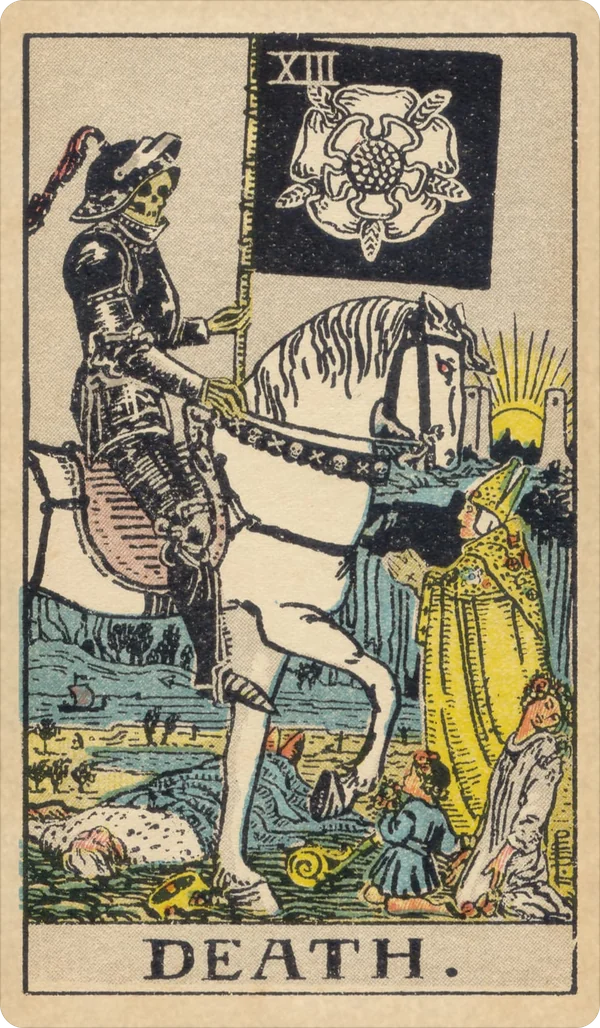
- Wheel of Fortune and Death
With Death, the turn is a true ending. The pair suggests a cycle closing completely so a new one can begin.
- Wheel of Fortune and Two of Pentacles
With the Two of Pentacles, the theme is balance in motion. The pair invites flexibility as priorities shift and juggle.
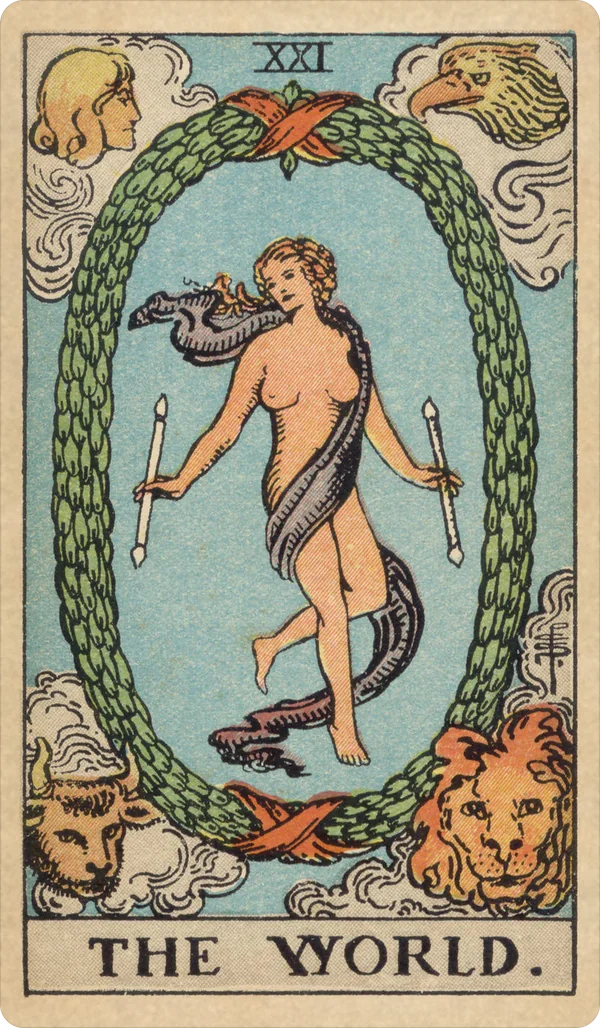
- Wheel of Fortune and The World
With The World, one full cycle is complete. The pair can mark the end of a long chapter and the start of another loop.
- Wheel of Fortune and Eight of Swords
With the Eight of Swords, feeling stuck may be more about mindset than circumstance. The pair asks which part of the trap is a story.
The most common misreading of Wheel of Fortune
The most common myth is that The Wheel of Fortune means good luck is coming, or that it is a lottery card. Beginners often treat it like a jackpot symbol. In the 1909 deck, the wheel goes down as well as up, and the image is about cycles and change, not winning. People also tend to think that the card means you have no control. The calm sphinx on top suggests that how you respond to change still matters.