The Emperor Tarot Card Meaning
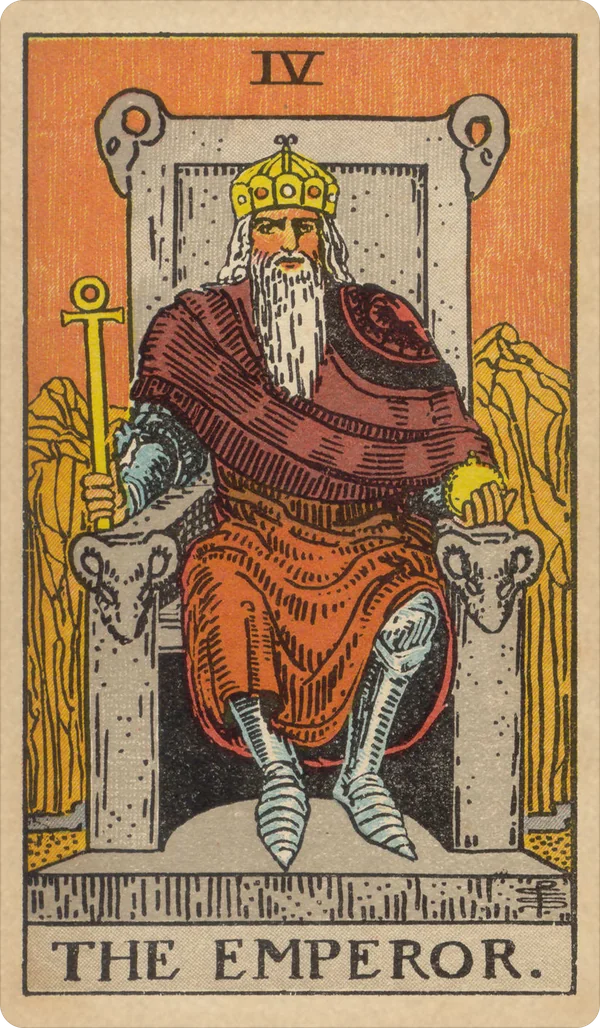
The Emperor
Pamela Colman Smith, 1909
- Upright
- structure · authority · stability
- Reversed
- rigidity · control · domination
- Arcana
- Major · Number IV
- Element
- fire
- Learn it in
- Day 10 of the 30-Day Tarot Path
In short
The Emperor is the card of structure and steady leadership. Upright, he stands for boundaries, routines, responsibility and the calm authority of someone who keeps their word. Reversed, he can show rigid control, power struggles, or a life with no frame at all. He asks what in your life needs a stronger foundation.
What you see on The Emperor card
Look first, read later: this is the Image-First Method from Day 5 of the course. Start with what is actually in the picture.
- Figure
- An older man with a long white beard sits on a heavy stone throne, wearing a gold crown, a red robe and a dark crimson cloak.
- Action
- He holds a gold scepter shaped like an ankh in his right hand and a round gold orb in his left, sitting upright and facing you directly.
- Setting
- Bare orange mountains rise on both sides of the throne, with no trees, flowers or people anywhere in view.
- Color
- The sky is a flat, hot orange, and the whole card is built from warm reds, oranges and stone gray.
- Detail
- Under the robe, steel armor covers his legs and arms. Four carved ram heads decorate the throne, two at the top corners and two on the armrests.
The Emperor upright meaning
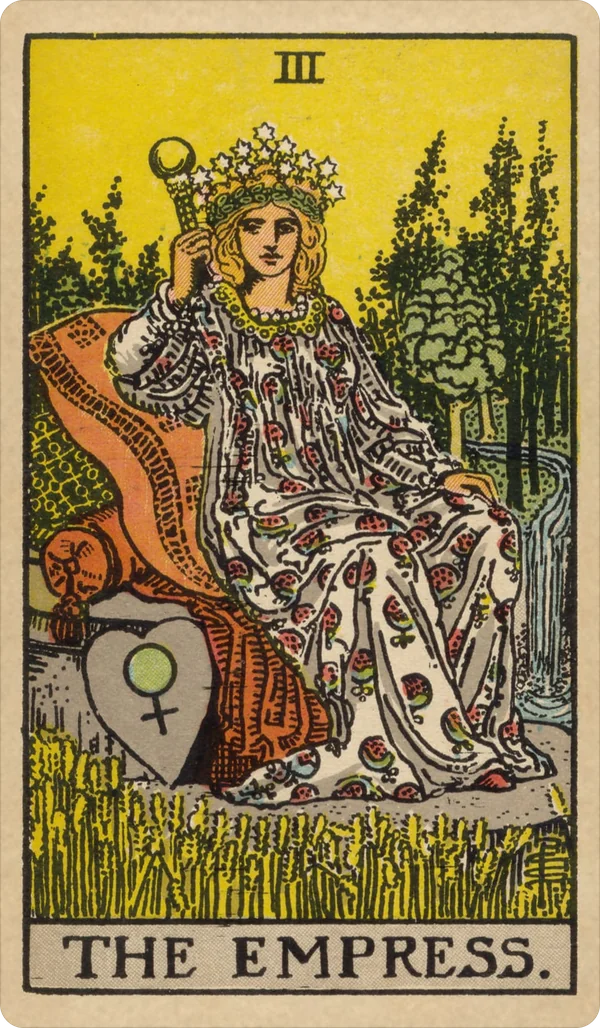
Compare The Emperor with the card just before him. The Empress lounges among wheat and waterfalls; The Emperor sits bolt upright on a block of stone in a dry, mountainous landscape. Where she grows things, he builds and protects them. Both are needed, and the pairing is one of the oldest lessons in the deck.
Upright, The Emperor points to structure. Schedules, budgets, house rules, clear agreements, a morning routine that actually holds. These things are not exciting, and that is the point. They create a stable floor so the rest of your life can move. The armor under his robe suggests he has been tested; his authority comes from experience, not from shouting.
The four ram heads carved into the throne add a fiery, headstrong edge to his calm. Rams charge forward; they do not wait for permission. He is not passive. He makes decisions and takes responsibility for them.
When this card shows up in a daily pull, ask where a little more order would help. Maybe it is a boundary you have been too polite to set, or a promise to yourself you keep breaking. The Emperor also invites you to notice how you relate to authority, your own and other people's. Can you lead without controlling? Can you follow without disappearing?
The Emperor reversed meaning
Upside down, The Emperor's structure tips into one of two extremes. On one side, rigidity: rules for the sake of rules, a boss or parent who cannot bend, or your own perfectionism running everything. On the other side, collapse: no routine, no boundaries, bills ignored, plans that never get a frame.
The reversal can also describe a power struggle, at home or at work, where everyone wants control and nobody wants responsibility. The card invites you to look at which way you are leaning. If you are too rigid, what could you loosen? If you are too loose, what one simple structure would help you feel steadier this week?
The Emperor in love and relationships
Upright in love
In love, The Emperor values reliability. He can describe a relationship built on clear commitments, shared plans and showing up when you said you would. For some people, this is deeply romantic: being able to count on someone. The card also invites healthy boundaries, saying clearly what you need and what you refuse to accept. If you are single, it may reflect wanting a steady partner rather than a whirlwind. Ask yourself what kind of stability you want to build, and what part of it you can offer.
Reversed in love
Reversed in love, The Emperor can point to control. One partner makes all the decisions, or affection depends on following rules nobody agreed to. It can also show the opposite: a relationship with no structure, where plans stay vague and commitments keep slipping. The card does not tell you who is to blame. It asks you to notice how power is shared between you and your person, and whether both of you feel safe enough to speak up.
The Emperor as feelings
As feelings, The Emperor reflects protectiveness, seriousness and a wish for stability. If you pull it while thinking about a connection, notice whether you feel secure, or whether you feel managed. It can describe strong loyalty that is shown through actions more than words. Rather than treat the card as a report on another person's heart, ask what you need in order to feel safe in this connection, and whether you are trying to control something that needs trust instead.
The Emperor in career and money
For work and money, The Emperor is the card of leadership, systems and accountability. It favors creating processes, setting clear expectations and taking ownership of a team or project. It can also point to dealing with a manager or institution that values rules. If you are self-employed, it invites you to build the boring structure your work needs: contracts, schedules, a simple bookkeeping habit. With money, he encourages planning and steady discipline rather than big swings, without promising any particular result.
The shadow side of The Emperor
The Emperor's shadow is control as a substitute for safety. When life feels unpredictable, it is tempting to grip everything harder: micromanaging partners or coworkers, needing to win every argument, treating feelings as weakness. Working with this shadow asks where your need for order is actually fear. It may also reveal your relationship with authority figures from childhood. Did you learn to obey, to rebel, or to become the one in charge so nobody could hurt you? Some people carry the opposite shadow. They avoid all responsibility and leadership because they once saw power used badly. Notice which pattern feels familiar. The healthy Emperor is firm but not cold, and he wears his armor under his robe, not as a wall.
The Emperor in yes-or-no questions
The Emperor is often read as a solid yes for career questions. On Tarot Habit, we avoid using cards to hand down verdicts about outcomes. The open question turns his energy into a plan, which suits a card that is all about building.
Instead of
“Will I get the promotion?”
Try
“What kind of leader do I want to be, and what structure or responsibility could I take on now that shows it?”
The Emperor as advice
In the advice position, The Emperor says: build the frame. Pick one area that feels chaotic, such as money, sleep or a shared home, and set one clear, simple rule for it this week. Keep it. Then notice how much calmer you feel when you are the one who keeps your word.
Journal prompts for The Emperor
- Where in my life do I need a clearer boundary, and what am I afraid of losing if I set it?
- How did the people who had authority over me as a child handle power, and how has that shaped me?
- The Emperor wears armor under his robe. What am I protecting, and is the armor still needed?
The Emperor with other cards
- The Emperor and The Empress
With The Empress, structure meets growth. The pair suggests a home, project or relationship that needs both care and firm support.
- The Emperor and Four of Pentacles
With the Four of Pentacles, the focus is on holding tight. Notice whether security has become fear of losing control.
- The Emperor and Two of Wands
With the Two of Wands, planning and leadership work together. The pair favors mapping out a long-range goal and taking ownership of it.
- The Emperor and King of Pentacles
With the King of Pentacles, steady authority meets practical skill. This pair often reflects building something solid over a long time.
The most common misreading of The Emperor
Beginners often think The Emperor must represent a specific older man in their life, a father, boss or partner. Sometimes it can, but very often it describes your own capacity for structure and leadership. Another myth is that he is a cold or harsh card. In the 1909 deck he is stern, but his role is to protect. Boundaries are a form of care, not cruelty.