King of Swords Tarot Card Meaning
King of Swords
Pamela Colman Smith, 1909
- Upright
- intellectual authority · truth · clear thinking
- Reversed
- misuse of power · manipulation · cruelty
- Arcana
- Minor · Swords
- Element
- air
- Learn it in
- Day 25 of the 30-Day Tarot Path
In short
The King of Swords is the mind in charge. Upright, he stands for clear thinking, fairness, ethics and authority earned through good judgment. Reversed, that authority can turn rigid, manipulative or coldly logical. As a person, he is the steady decision maker people turn to. He asks whether your reasoning serves people or only rules.
What you see on the King of Swords card
Look first, read later: this is the Image-First Method from Day 5 of the course. Start with what is actually in the picture.
- Figure
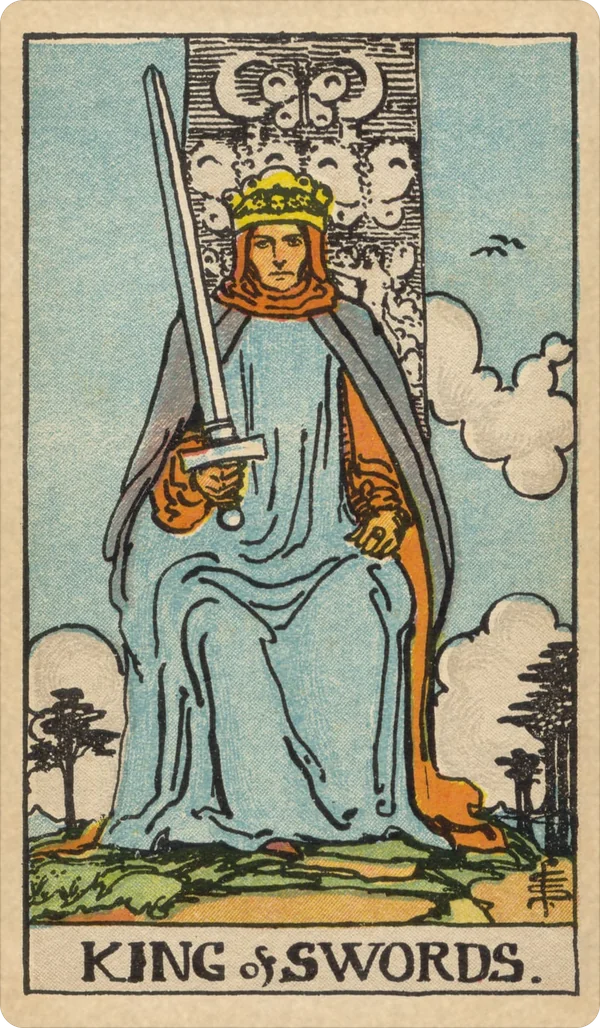
- A king sits on a stone throne facing straight out at the viewer, wearing a gold crown, a long pale blue robe, orange sleeves and a gray cloak over his shoulders.
- Action
- He holds a sword in his right hand, tilted slightly to one side rather than perfectly upright, and rests his left hand on his lap. His expression is calm and unreadable.
- Setting
- Low clouds and dark trees sit behind him on both sides, and he is placed on a patch of green ground under an open sky.
- Color
- Pale blue fills the sky and his robe, giving the card a cool, airy tone warmed only by the orange of his sleeves and collar.
- Detail
- The tall back of his throne is carved with butterflies and crescent moons, and two small birds fly in the sky to the right.
King of Swords upright meaning
Kings in tarot are the suit's energy put to work in the world. The King of Swords is what happens when clear thinking is given responsibility. Unlike his Queen, who sits in profile, he faces you directly. You cannot slip past him with a vague story. He wants the facts.
Upright, the card points to sound judgment and fairness. You might be the one making a hard call at work, mediating a dispute between friends, or setting the rules for a project. He favors logic, ethics and long-term thinking over moods and drama. This is the card of the good judge, the trusted doctor, the thoughtful teacher or the clear-headed manager, someone whose authority comes from being reliable and wise rather than loud.
Look at his sword, though. It tilts slightly. Perfect logic is rare, and this king seems to know it. His decisions lean toward what is fair in a real situation, not only what is correct on paper. The butterflies carved behind him are a quiet reminder of change and transformation. Even the strongest reasoning has to adapt.
As a person, the King of Swords can describe a calm, principled, analytical style. In a daily pull, ask what decision is waiting for you, and what a fair, clear-minded version of you would choose.
King of Swords reversed meaning
Reversed, the King of Swords can use his sharp mind in the wrong direction. Logic becomes a weapon, rules become a way to control, and fairness gives way to winning. You might notice someone twisting facts to make a point, or catch yourself being rigid because flexibility feels like weakness.
Sometimes the reversed card points instead to avoiding responsibility for a decision. You might hide behind policies or let others make the hard call so nobody can blame you. The card asks you to check where your thinking has stopped serving people and started serving your pride or your fear, and to own the call you actually made.
King of Swords in love and relationships
Upright in love
In love, the King of Swords brings maturity, honesty and steady communication. He may describe a partner who talks problems through calmly, or a moment when you approach your relationship with a clear head instead of a racing heart. It favors fair agreements, mutual respect and keeping your word. If you are single, it may point to knowing exactly what you are looking for. The card invites you to combine clear thinking with genuine warmth, so logic supports love instead of replacing it.
Reversed in love
Reversed in love, the King of Swords can point to coldness, control or arguments won with logic but lost in feeling. One partner may dismiss the other's emotions as irrational, or use rules and conditions instead of care. It may also show you holding back emotionally because feelings seem less safe than facts. The card asks you to notice whether you and your person are trying to understand each other or simply trying to be correct.
King of Swords as feelings
As feelings, the King of Swords points to measured, thoughtful emotions in the connection. Someone may care deeply and still express it through reliability, advice and problem solving rather than open affection. The card asks you to notice whether you are thinking about your feelings instead of feeling them. As a person, this energy shows love by being steady, honest and fair, even when it is not very expressive.
King of Swords in career and money
In a career spread, the King of Swords is the card of leadership through clear thinking. It may point to a promotion into a decision-making role, writing a policy, negotiating a contract or advising others. It favors expertise, ethics and strategy. The card also asks you to stay human in your decisions: explain your reasons and listen to the people affected. In money matters, it suggests a logical, informed approach, like checking the terms, comparing options and planning before acting. It is not financial advice, just a nudge toward clarity.
The shadow side of King of Swords
The hidden edge of the King of Swords is the person who has to be the smartest one in the room. Clear thinking can turn into an identity, and then every disagreement feels like a threat. Some people use reason to stay far from emotion, explaining feelings away instead of having them. Others enforce rules strictly because chaos once felt dangerous to them. Shadow work with this card asks: When do I use logic to avoid being vulnerable? Whose feelings have I dismissed because they did not make sense to me? The king faces straight forward and gives little away. Consider what it would take for you to let someone see the thinking behind your face.
King of Swords in yes-or-no questions
The King of Swords is often read as a confident yes because he looks so certain. In this practice, we don't use cards for yes-or-no verdicts. The rewrite gives you his tools: facts, values and fairness.
Instead of
“Am I making the right decision?”
Try
“What are the facts, what are my values here, and what would a fair choice look like for everyone involved?”
King of Swords as advice
As advice, the King of Swords says: think it through, then own it. List the facts, name your values and make the call. Explain your reasoning to anyone affected, and leave room to adjust if you learn something new. Clear decisions get stronger when they are shared openly.
Journal prompts for King of Swords
- What decision am I avoiding, and what would I choose if I simply looked at the facts?
- Where has my logic become a wall between me and other people's feelings?
- What does fairness mean to me, and where am I living up to it right now?
King of Swords with other cards
- King of Swords and Justice
Justice and the King of Swords both hold up the blade of fair judgment. Together they point to a clear, ethical decision based on facts.
- King of Swords and King of Cups
The King of Cups brings emotional wisdom to the King of Swords' logic. Together they suggest leadership that is both clear and caring.
- King of Swords and The Emperor
With The Emperor, structure and authority double up. Together they ask whether your rules are serving people or just keeping control.
- King of Swords and Five of Swords
The Five of Swords next to this King can point to winning through clever arguments. Together they ask whether you are using logic fairly.
The most common misreading of King of Swords
On r/tarot, a frequent assumption is that the King of Swords is always a cold, older man in a position of power, like a strict boss or a lawyer on the other side. Beginners often look for him in their lives. In this course, court cards are first read as an energy you can recognize in yourself, regardless of gender or age. Another myth is that he has no feelings. He has them; he simply thinks before he shows them.